Does Geopolitics eat Sustainability for Breakfast?
On May 13 CBS Executive Fonden hosted an insightful Sustainability Summit, bringing together senior leaders from business, academia, and public affairs to explore this urgent and timely question. In this article we have gathered all the key takeaways from the key-note speakers at the event.

An urgent conversation
Yesterday, CBS Executive Fonden hosted an insightful Sustainability Summit, bringing together senior leaders from business, academia, and public affairs to explore this urgent and timely question.
In this article we have gathered all the key takeaways from the key-note speakers at the event.


Sustainability is resilience
Anne Marie Jess Hansen, CEO, CBS Executive Fonden opened the summit with a clear message: Sustainability is a strategy for resilience. We must think beyond compliance and competition. What we need now is proactive leadership grounded in optimism and the ability to connect across diverse perspectives that sets the direction.
Geopolitics will NOT eat sustainability for breakfast
David Bach, President of IMD, offered a cautiously optimistic view: Europe is advancing on renewables and energy resilience. We are witnessing a breakdown of the US commitment to Europe, and this will be difficult to repair. Europe should reduce its dependence on the US. But sustainability is now inseparable from security and competitiveness. To stay ahead, Europe must scale infrastructure, secure supply chains, reduce energy costs without jeopardizing sustainability, and lean into strategic autonomy. A more secure, sustainable, and competitive Europe is within reach — if we lead boldly.


In the end Bach quotes Jean-Claude Juncker
We all know what we need to do, but we do not know how to be reelected when we have done it— Jean-Claude Juncker, Former President of the European Comission
And so David Bach ends with a plead to stay courageous: “We need leaders who see this as an opportunity to invest in bolstering our competitiveness.”
A wake-up call for Europe
Ulrik Vestergaard Knudsen reminded us that Europe can no longer assume continued US leadership in global affairs. The world supremacy battle will be about technology and therefore Europe must invest ambitiously in digital capabilities, green innovation, and strategic independence to stay in the game. He emphasized the urgency of cross-sector collaboration and structural reform — warning that, without action, sustainability risks becoming a luxury we can no longer afford. His conclusion: “Geopolitics is already eating sustainability for breakfast.”
Technology is part of the answer
Natasha Friis Saxberg called for a long-term, systemic approach to sustainability — not short-term fixes. She argued that sustainability must be embedded into how we rethink supply chains and operations. Europe, she noted, excels in using tech but lags in producing it. Europe is also experts in science but not in commercializing it. To address this, we must invest in green technology, attract global talent, and scale the right technologies more rapidly. Saxberg sees three main struggles ahead of us: Climate change, democracy, and defence budget. We have to stop hitting the snooze button.

She also emphasized the importance of regulation in regard to the sustainable agenda. Regulations work because it changes behavior. When sustainability is a part of operations, we will probably succeed.
Leadership matters more than ever
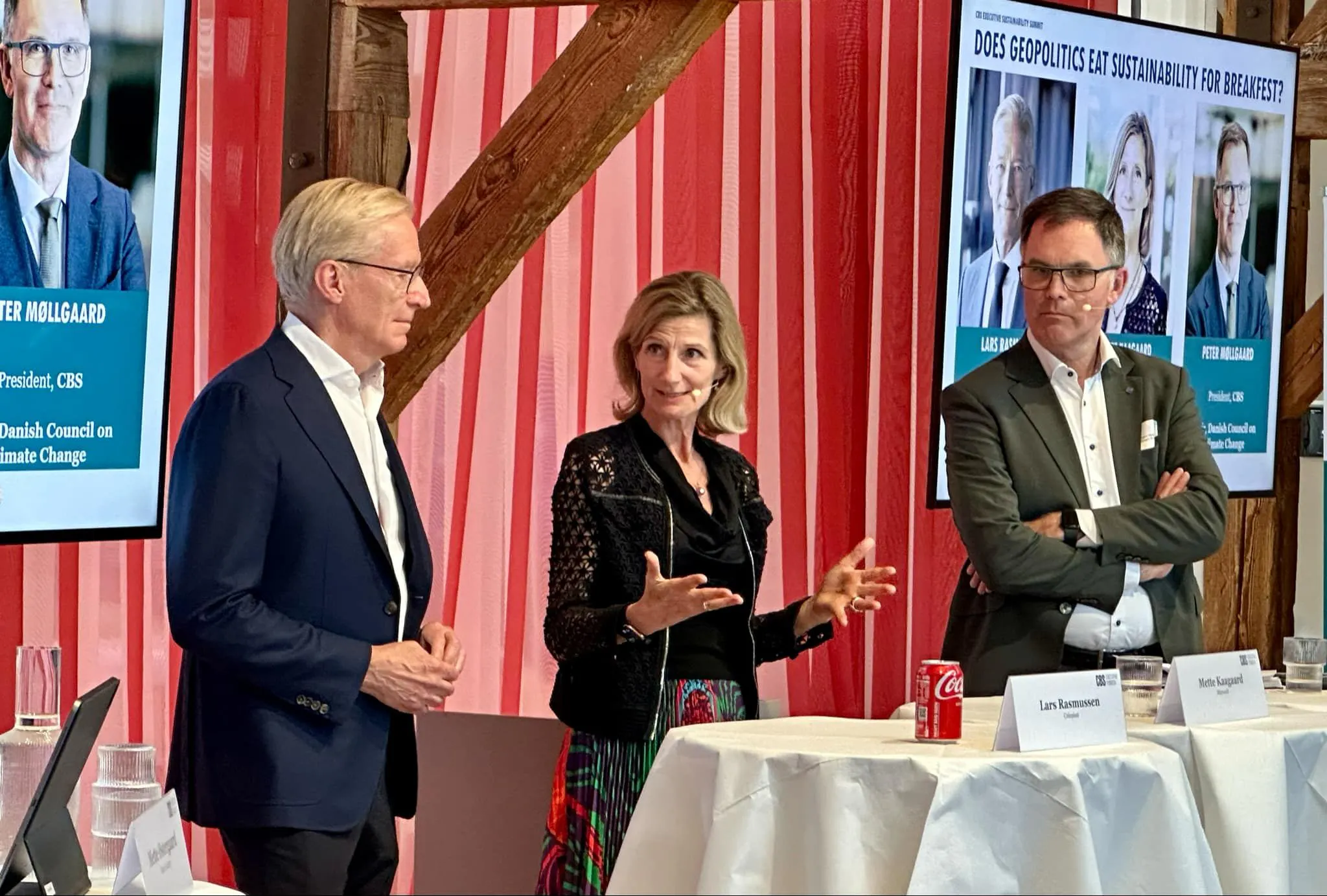
Panelists Mette Louise Kaagaard, CEO, Microsoft Denmark, Lars Rasmussen, interim CEO Coloplast, and Peter Møllgaard, President of Copenhagen Business School (CBS) and chair of the Danish Council on Climate, highlighted the evolving role of business: Companies must stay committed to sustainability even amid shifting priorities like defense and economic pressure. If Denmark wants to stay a pioneer country, we have to stay ahead.
Tech solutions were all noted – but values-based leadership remains essential. We need to stand on our values – it’s the answer to the disorder, as Peter Møllgaard concluded.

The path forward?
Advance renewables, embrace digital transformation, invest in resilient supply chains – and recognize that defense, economy, and energy security are now inseparable. Europe must leverage its capital markets to support innovation, greentech, and long-term competitiveness.
- Catharina Lebowski

